


As a Spaniard, I feel like criticising Zara publicly might get my passport revoked, but here we are.
I’ve just discovered something about the new John Galliano x Zara Re{form} collection and I genuinely had to read it twice.
Because look at these clothes.
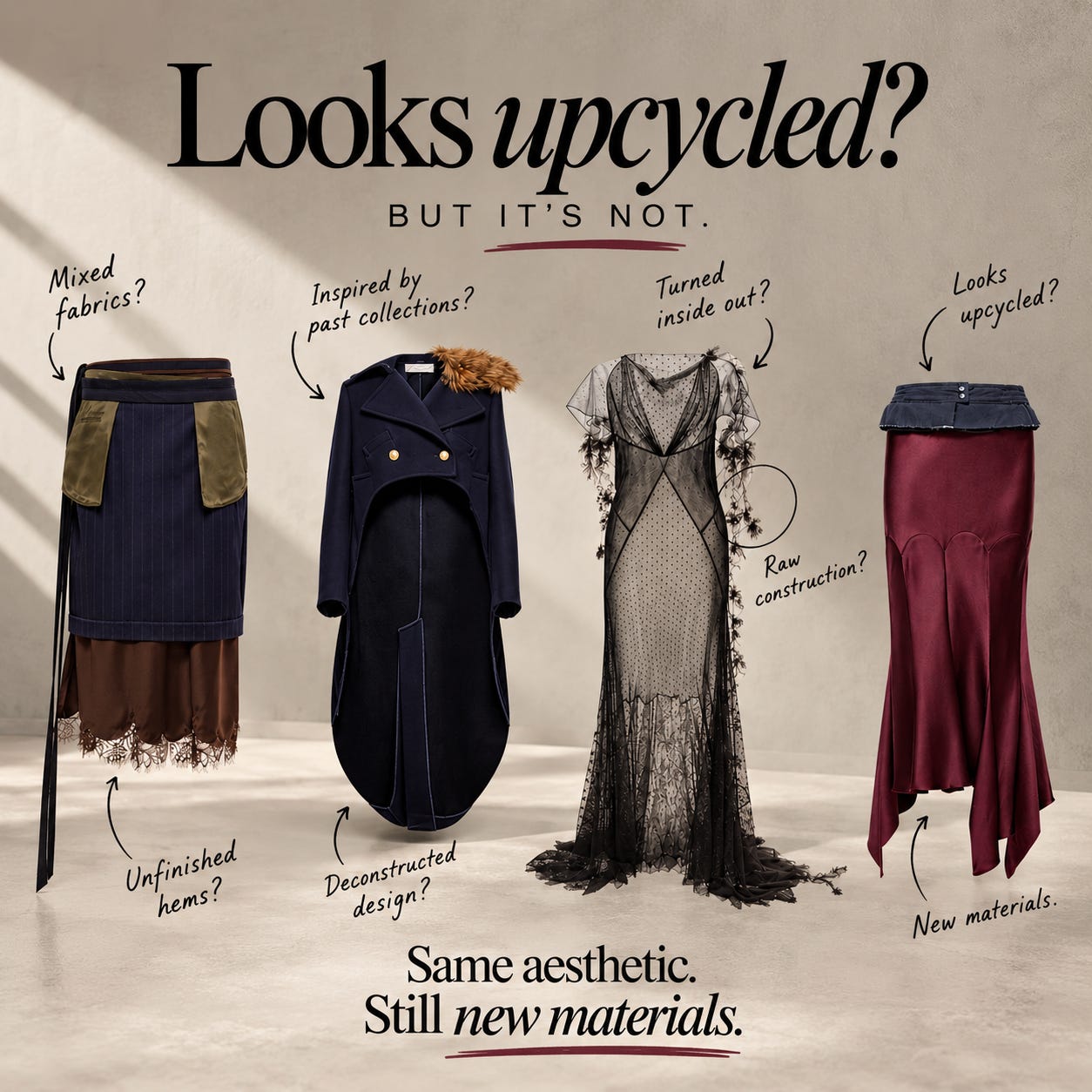
Unfinished hems. Layers that look like they’ve been taken from different garments. Things turned inside out. Pieces that look dismantled and put back together again.
The collection is called Re{form}.
Galliano talks about going into Zara’s archives, taking existing pieces, cutting them, reversing them, changing their proportions, pulling them apart and creating something new from them.
Lovely.
Upcycling, right?
NO.
Well… not quite.
The archive pieces were part of Galliano’s creative process. They became prototypes. The designs that you and I can actually buy were then reproduced in new materials.
Sorry, WHAT?
So we’re making new clothes look like old clothes that have been transformed into new clothes? 🤯
Fashion really does keep me humble.
And listen, creatively, I actually LOVE the idea.
Galliano taking a completely ordinary Zara garment, ripping apart everything we understand it to be and asking what else could this become?
That is fashion.
That is creativity.
That is exactly the kind of thing that makes me excited about clothes.
My issue is somewhere else.
Because we are living through a moment where words like archive, reform, rework, circular, conscious, rescued and reimagined carry currency.
We WANT to believe we’re consuming differently.
And apparently we’ve now reached the point where even sustainability has developed an aesthetic.
Make it slightly unfinished.
Put a seam somewhere unexpected.
Turn something inside out.
Add a piece of lace that looks like it once belonged to somebody’s grandmother.
Voilà.
It looks rescued.
Except looking upcycled doesn’t make something upcycled.
In the same way that putting my gym clothes on doesn’t mean I actually went to Pilates.
Believe me, I’ve tested this theory.
I know what upcycling looks like because I’ve watched it happen properly.
My friend and business partner Rickylee and I once went down to Margate and spent the day digging through vintage.
And when I say vintage, I don’t mean a T-shirt from Zara’s 2022 collection that somebody has decided is now archive.
I’m talking clothes that have already lived.
Pieces from different brands, years and eras. Clothes somebody designed, somebody bought, somebody wore, somebody eventually gave away and which somehow survived long enough for two women to find them in Margate decades later and start imagining another life for them.
That’s where it gets exciting.
You take what already exists.
You look at the construction, the fabric, the history, the details worth saving.
Then you ask,
What could this become now?
Rickylee does this through her own creative work, and it’s something we’ve explored through What’s Worth Wearing because we’re fascinated by the people who can look at something the rest of us might dismiss as finished and see raw material instead.
That, to me, is upcycling.
Not necessarily making something look old.
Making something old matter again.
And there is a difference.
An important one.
Especially now.
Since 19 July this year, large companies in the EU have been prohibited from destroying unsold clothing, accessories and footwear except under limited exemptions. The rules specifically push businesses toward keeping products in use through routes including resale, donation, repair, refurbishment and remanufacturing.
Which I think is brilliant.
But it also means words around circularity are only going to become more valuable in fashion.
And whenever something becomes valuable in marketing, we need to start paying attention to the difference between doing the thing and looking like you’re doing the thing.
Now, to be fair to Zara, I haven’t found them actually claiming that this collection is upcycled.
And that’s important.
The project is described as Galliano “re-authoring” Zara’s archive. Zara’s own collection page calls it Re{form}, and coverage of Galliano’s process makes clear that existing garments were the starting point for designs ultimately made in new materials.
So perhaps the interesting question isn’t:
Is Zara lying?
I don’t think that’s the useful accusation here.
The question I’m much more interested in is:
When the visual language of sustainability becomes fashionable, how easily do we start confusing the appearance of circularity with circularity itself?
Because those aren’t the same thing.
And consumers shouldn’t need a degree in textile manufacturing and three hours of investigative journalism before buying a skirt to understand the difference.
If it’s new, tell me it’s new.
If it’s inspired by an archive, wonderful. Tell me that.
If it’s made from deadstock, tell me.
If you’ve rescued an existing garment, dismantled it and turned THAT MATERIAL into something new, tell me.
I’ll probably love you for it.
Just don’t put a distressed hem on a newly manufactured skirt and expect Mother Earth to start clapping.
And perhaps this is also why I keep becoming more interested in independent designers, makers, vintage dealers and the people Rickylee and I are trying to discover through What’s Worth Wearing.
Because when you actually meet the person making the thing, you can ask:
Where did this come from?
What was it before?
Why did you make it this way?
What happened to the material?
And suddenly sustainability stops being a lovely paragraph written by a marketing department.
It becomes a process you can actually see.
So yes, Zara, I still love you.
I’m Spanish, it’s complicated 🇪🇸
And Galliano’s collection is visually fascinating.
I might even want half of it.
Which is deeply inconvenient for the argument I’m currently making(although it’s being a very long time since I bought a new addition to my wardrobe).
But maybe that’s precisely the point.
Something can be beautiful, creative, desirable and culturally interesting…
and we can still ask better questions about what it actually is.
Because a garment that looks upcycled isn’t necessarily upcycled.
A collection inspired by an archive isn’t necessarily circular.
And sustainability isn’t a design aesthetic.
At least, I hope it isn’t becoming one.
Signed,
A Spanish woman potentially banned from Zara for life.
P.S. If you want to understand what I mean by actual reworking rather than the look of reworking, I’ll leave Rickylee’s work here, Reloved by Rickylee. She’s one of those annoying creatives who can look at something everyone else has finished with and immediately see what it could become next.