


I have a question for you.
When was the last time you looked in the mirror and immediately noticed something you liked?
Not after checking whether your stomach looked flat enough, your arms were behaving themselves or that bloody wrinkle between your eyebrows had finally decided to pack its bags.
I mean, actually looked at yourself and thought, God, I love that about me.
Because I find it fascinating how we can stand in front of a mirror with an entire human being looking back at us, and somehow our eyes go straight to the three square centimetres we’re unhappy with.
And the funniest thing is that sometimes the feature we’ve spent half our lives trying to hide is exactly the one someone else finds beautiful.
Anyway, let me tell you what happened on Monday.
I went to my hip-hop class. Yes, I do hip-hop. No, I’m not particularly good at it yet, but I have a wonderful time pretending otherwise.
I normally go on Wednesdays, but this week I changed my class to Monday, and there I bumped into a model I worked with earlier this year.
We started chatting, and he was telling me how incredible this London Fashion Week had been for him. His career has really started taking off, his agency is calling him for bigger projects, including opportunities connected with GQ, and suddenly he’s finding himself in rooms he wasn’t getting into before.
And then he said something that really stayed with me.
He’s Indian, dark-skinned and not particularly tall by traditional male modelling standards. For a long time, he thought those things were working against him because he didn’t look like the men he believed agencies wanted.
And now those are precisely the characteristics they’re calling him for.
His look is distinctive. You remember him.
He told me that something shifted when he stopped seeing those features as disadvantages and started embracing them, and I found that SO interesting because imagine spending years thinking you need to look more like everybody else to succeed, only to discover that the reason people want you is because you DON’T.
The irony.
And I couldn’t stop thinking about how often I see exactly this with women.
Not necessarily in modelling, but in everyday life, where we seem to spend an extraordinary amount of time negotiating with our own bodies.
Think about the woman with beautiful broad shoulders who never wears anything sleeveless because she’s convinced they make her look masculine. Or the woman with a fuller bust who hides underneath oversized tops because she doesn’t want to draw attention to it.
Then there’s the woman with gorgeous curves who has decided that black, loose clothing is her only option, and the woman with a prominent nose who has spent twenty years wishing she had somebody else’s profile, while another person looks at her and sees the most interesting face in the room.
And I’m not suggesting that every feature we dislike is secretly going to become our favourite. Sometimes we simply don’t love something about ourselves, and that’s fine.
But I wonder how much of our personal style we sacrifice trying to make those things disappear.
Because there’s something I’ve noticed working with clients, and it happens so often that I now recognise it almost immediately.
The parts of our bodies we’re most determined to hide often become the very parts we accidentally emphasise.
Think about it.
When you’re getting dressed with the sole intention of concealing something, every decision revolves around it. Instead of asking yourself whether you actually love the outfit, you’re checking whether it hides your stomach. And rather than enjoying the beautiful neckline, the proportions, the colour or how the fabric moves, you’re busy examining whether your hips look smaller.
Sometimes, in the process of trying to conceal one feature, you end up creating a silhouette that draws even more attention to it.
I see women who feel uncomfortable about their stomach choosing oversized tops because they believe the extra fabric will hide everything, when depending on the cut and where the fabric falls, it can actually add volume to the area they’re trying to minimise.
Or women who avoid anything fitted because they’re self-conscious about their hips, without realising that the shape they’ve chosen is completely disguising their waist and changing the proportions of their entire silhouette.
And this is not because they’re doing anything wrong. It’s simply because nobody has ever taught them how clothing actually works on their particular body.
This is the part of styling that I find absolutely fascinating, because clothes aren’t just pieces of fabric we put on.
They’re lines, shapes, proportions, textures and colours, and every morning we’re arranging all of those elements around our bodies, whether we’re conscious of it or not.
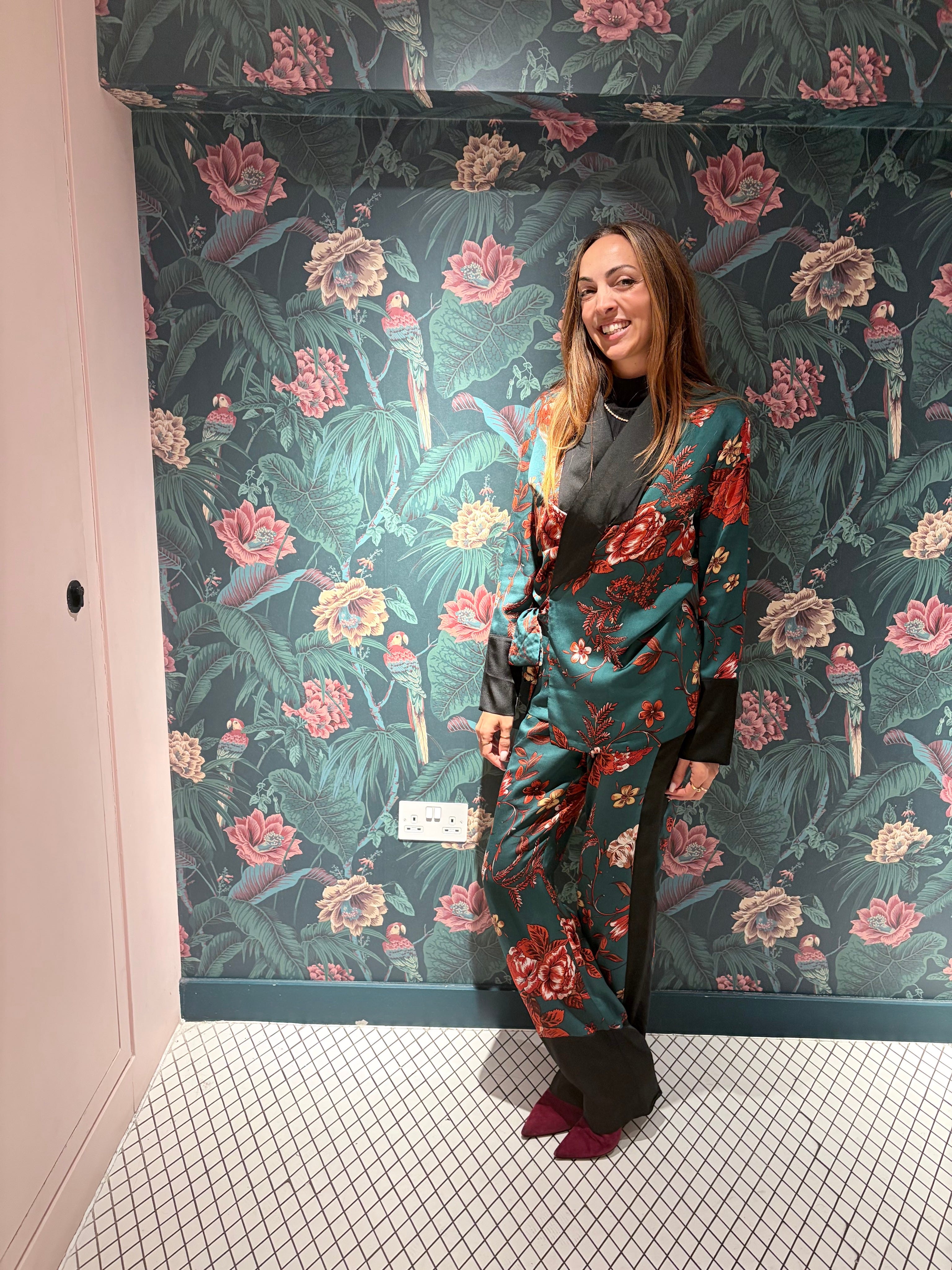
A neckline can change where the eye travels, the length of a jacket can completely alter the proportions of an outfit, and something as simple as the placement of a waistline or the way trousers fall from the hips can change what we notice first.
It’s almost architectural, which is probably why I ended up calling my method The Wardrobe Architect.
And once you understand these principles, you can start using styling to build a visual composition around your body, directing attention towards the features you love and allowing the ones you’re less enthusiastic about to become quieter.
You don’t need to change your body to do any of this. You need to understand it.
And that understanding gives you options.
Perhaps you love your legs but aren’t particularly fond of your stomach. Fine! We can work with that. Maybe you have beautiful shoulders, a gorgeous neckline or a waist you’d love to emphasise, but you’ve spent years hiding all of it because you’ve been so focused on something else.
We can work with that too.
But there’s a difference between getting dressed thinking what do I need to hide today? and opening your wardrobe wondering what would I love to show?
And I think that little shift changes much more than the outfit.
Because the moment you stop organising your appearance around the things you dislike, you begin noticing everything else that’s been there all along.
You discover the colours that make your skin look incredible, the cuts that work beautifully with your proportions and those particular outfits that make you walk a little differently because you KNOW you look good.
Suddenly getting dressed becomes something creative again, something you participate in rather than something you endure.
I often wonder how many women have wardrobes full of perfectly good clothes but never really enjoy wearing them because they’ve spent so long looking at themselves through the lens of what’s wrong.
And honestly, who decided those things were wrong in the first place?
Fashion changes its mind every five minutes.
One decade we’re supposed to be thin, then we’re supposed to have curves, and then apparently we need the waist of one woman, the hips of another and the face of someone who hasn’t aged since 2007.
Very reasonable expectations. Thank you, everyone.
Meanwhile, beauty has always been subjective, and if you think about the people you find attractive, I doubt they’re all the same height, the same shape or have identical faces.
Sometimes it’s somebody’s smile, a strong nose, a gap between the teeth, an unusual face or simply the way somebody moves and carries themselves.
Something that makes them unmistakably them.
And that’s what I loved about the conversation with the model, because the features he once considered obstacles have become part of what makes his professional identity so distinctive.
He didn’t need to erase them. In fact, the very idea of trying to erase them now seems rather ridiculous, doesn’t it?
Of course, we’re not all trying to become models or build careers around our appearance, but we’re all communicating something through how we present ourselves.
And I think there’s a connection here with personal branding that we don’t talk about enough.
We’re constantly being told to build a personal brand, be memorable, stand out, differentiate ourselves… and then we go and try to look like everybody else.
How ridiculous is that?
We copy the same outfits, the same aesthetic, the same idea of what a successful woman is supposed to look like, and sometimes we hide the very things that could make our presence unmistakable.
I’m not suggesting you need to turn every insecurity into your signature feature. You don’t have to wear something that makes you uncomfortable just to prove you’ve accepted yourself.
But perhaps you could start questioning whether that feature really deserves all the attention you’ve been giving it.
Because maybe it’s not the feature that’s holding you back as much as the relationship you’ve developed with it.
And this brings me to something I’ve been wanting to write about for a while.
Being pretty is a feeling.
I don’t mean that physical appearance doesn’t exist or that everyone will find everyone beautiful. They won’t, and thank God for that, otherwise we’d all be fighting over the same man.
Exhausting!!
What I mean is that how beautiful you feel has an enormous influence on how you experience yourself.
Think about the difference between going out wearing something you feel uncomfortable in, spending the entire evening pulling at your clothes, checking your reflection and wondering whether you’re standing at the right angle, and going out wearing an outfit that makes you feel absolutely fantastic.
You’re still the same woman.
But in the second scenario, you’re probably enjoying the conversation instead of wondering what your stomach is doing. You’re laughing, moving, making eye contact and actually participating in whatever is happening around you, rather than using half your brain to monitor how you look.
And people get to experience more of you because you’re no longer so preoccupied with everything you think you need to correct.
That’s the part I wish more women could experience.
And perhaps it begins with something very simple.
Tomorrow morning, when you open your wardrobe, instead of asking yourself what you need to hide, ask yourself what you love about your appearance today and how you could dress to celebrate it.
It might be your legs, your shoulders, your hair or your beautiful bum. Yes, your bum deserves recognition too.
Start there.
Learn how your clothes work with your body. Play with shapes, proportions and colours, and pay attention to the outfits that make you feel wonderful, because there’s usually a reason they work so well.
In fact, this is one of the exercises I encourage women to do before they even think about buying more clothes.
Start looking for the patterns in what you already love wearing.
Why do you always feel fantastic in those particular trousers? What is it about that jacket that makes every outfit look better? Why do you keep reaching for the same neckline or the same dress shape?
Those little repetitions tell us an enormous amount about our personal style, and once you begin recognising them, you can start making much more intentional decisions about what you wear.
I’ve actually put together a free Wardrobe Pattern Assessment to help you do exactly that.
When you subscribe to this newsletter for free, you’ll receive the assessment, which guides you through looking at your own wardrobe, identifying the cuts, shapes and details that consistently work for you, and beginning to understand why.
You can start putting everything we’ve talked about today into practice with the clothes you already own, rather than rushing out to buy something new.
Because I don’t want you to finish reading this, feel inspired for approximately seven minutes and then go back to standing in front of your wardrobe tomorrow morning thinking about everything you need to hide.
I want you to actually experiment with it.
And if there’s a feature you’ve spent years calling a flaw, perhaps give it another look. Not to force yourself to love it, but to see whether you’ve been judging it through somebody else’s idea of beauty.
That model I met on Monday reminded me of something I see in my work all the time.
Sometimes the thing that makes you different is the very thing that makes you memorable.
And what a shame it would be to spend your whole life trying to make it disappear.
Love,
Carolina x
P.S. I’m curious. Is there a feature you used to dislike about yourself that you’ve actually grown to love? Or one that somebody else complimented and made you think, Wait, THAT? Really? I’d genuinely love to hear it.