


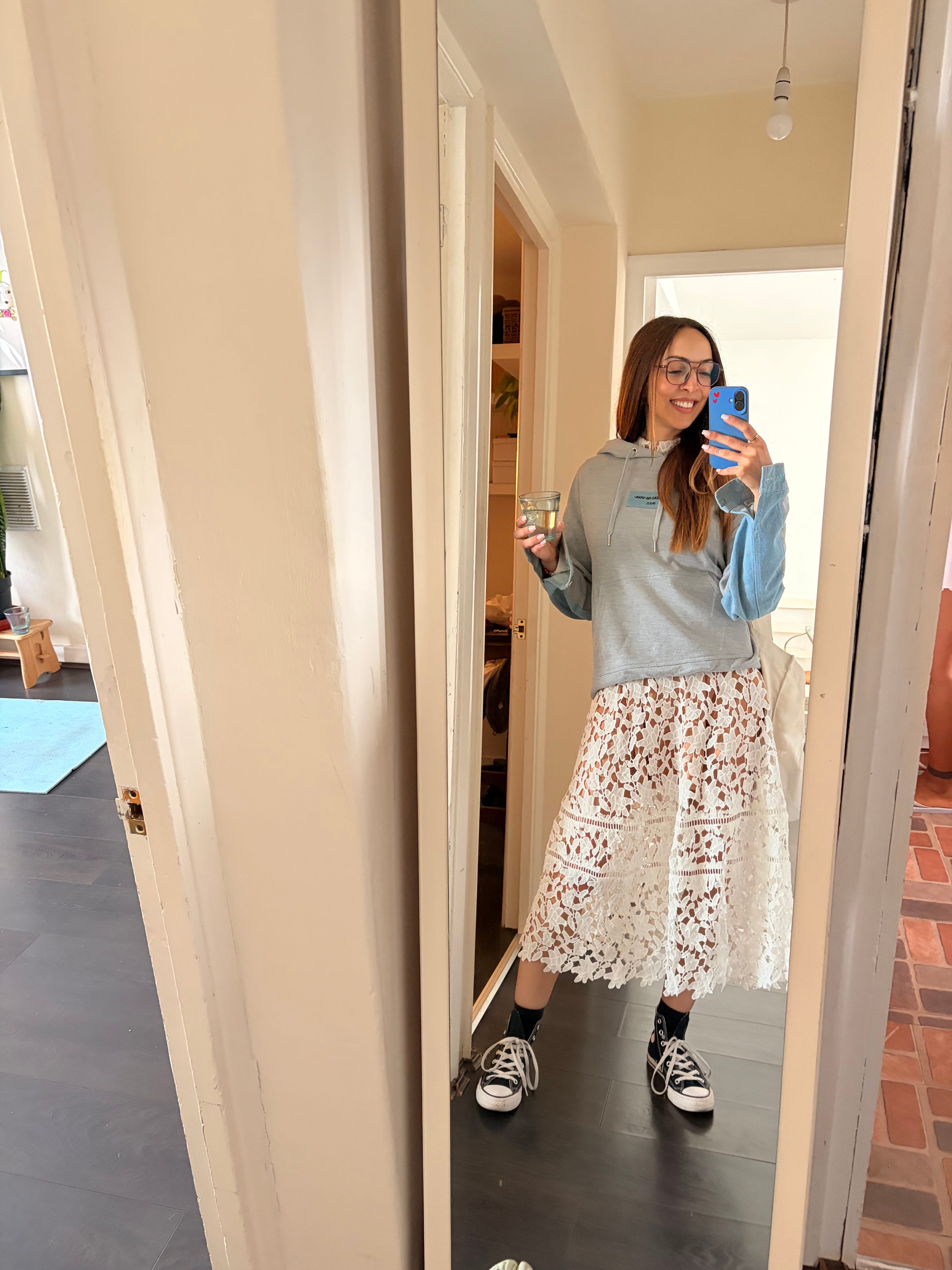
A woman once asked me a question that I think deserves a much longer answer than the one we usually give it.
“Carolina, why can I have a wardrobe full of clothes I love, but when I put them together, something always looks wrong?”
And I LOVE this question.
Because there’s something incredibly frustrating about standing in front of the mirror wearing perfectly lovely clothes and wondering why on earth you look nothing like the woman you had imagined five minutes earlier.
You like the top. The skirt is beautiful. The shoes are fabulous, and you’ve seen somebody wearing something similar on Instagram, so surely this should work?
Except it doesn’t.
You start changing things. Perhaps it’s the shoes? You try another pair. Still not right. Maybe you need a belt? You add one, look again and somehow it’s even worse.
At this point, you begin questioning the entire purchase history of your wardrobe.
And eventually you return to the same outfit you wore on Tuesday because you’ve run out of time and patience.
Wonderful.
Another morning spent negotiating with pieces of fabric.
But here’s what I find fascinating about this situation.
Most women assume that if the outfit isn’t working, one of the garments must be wrong.
Maybe the skirt doesn’t suit them, the top is unflattering or the shoes were a terrible investment.
And sometimes that’s true.
But very often, there’s absolutely nothing wrong with the individual pieces. The problem is how they’re interacting with one another.
Which is a completely different thing.
Let me explain.
I have a beautiful white summer dress that I absolutely love, but whenever I wear it on its own, I’m not particularly enthusiastic about what it does to my proportions.
I’m petite, and depending on how a garment is constructed, sometimes the fabric ends up wearing ME rather than the other way around.
Which is lovely for the dress, obviously. Less exciting for the woman inside it.
Now, I could decide that the dress doesn’t suit me, that I should have bought something more fitted (although I actually got it from a clothes swap!), or perhaps that I need to change something about my body.
Because apparently that’s where our brains like to go.
Very helpful. Thank youu.
But I wouldn’t begin by changing my body, buying another dress or declaring war on loose-fitting clothing.
I’d look at what’s actually happening.
The dress falls in a way that doesn’t give me the proportions I particularly enjoy. There’s very little structure around my upper body, and the overall silhouette isn’t creating the effect I want.
So the other day, instead of deciding the dress wasn’t working, I started playing with it.
I added a colourful waistcoat over the top.
And suddenly the entire outfit changed.
The waistcoat introduced structure to my upper body, changed the visual balance and gave me a completely different silhouette.
Same dress, same body,… completely different result.
Nobody needed to call Vogue.
And that’s the interesting part.
I hadn’t changed anything about the dress itself. I’d simply introduced another piece that changed how the different parts of the outfit related to one another.
Now imagine if I had looked at that dress the first time, decided it didn’t flatter me and pushed it to the back of my wardrobe.
I might never have discovered that possibility.
And this is something I wish more women understood about personal styling.
You don’t need to know immediately what the perfect outfit looks like. You need to learn how to recognise what’s preventing the one you’re wearing from working.
And that is a skill.
I realise fashion is one of those things people often describe as natural. You’re either good at putting clothes together or you’re not.
Which I find slightly unfair.
Imagine saying that about cooking.
Some people can open a fridge, find three ingredients and somehow produce a beautiful dinner. I open my fridge at the end of a particularly long day and sometimes stare at a courgette as though it’s going to offer me a business proposal.
But I know perfectly well that somebody who understands flavour, ingredients and cooking techniques will have more options than somebody who has only learnt to follow one recipe.
I think styling works in a similar way.
And it’s not that everybody needs to become a stylist. God forbid, I’d be out of business.
But understanding a few fundamental principles can make getting dressed enormously easier.
Let’s go back to the dress for a moment.
What if adding the waistcoat hadn’t worked?
Well, then I’d have tried something else.
Perhaps the waistcoat was too long and created another proportion I didn’t particularly like. Maybe it added too much volume around my waist, or perhaps the shape was fine but the fabric didn’t work with the dress.
Good! We’re investigating.
I might try a different layer, change the shoes or experiment with defining my waist.
Not because there’s a rule saying petite women must wear particular cuts or always emphasise their waist. There isn’t, and if someone tells you there is, I’d be very interested to know who appointed them head of the Petite Women’s Department.
I’d simply be exploring what happens visually when I change one element.
And there’s an important difference between randomly changing clothes because you don’t like what you see and deliberately experimenting to understand what’s happening.
One is frustrating.
The other teaches you something.
And this is where my obsession with what I call Body Architecture comes in.
I don’t look at a woman’s body simply to put her into a category and announce that she’s a pear, an apple or an hourglass.
Those descriptions can sometimes be useful as a starting point, but they tell me very little about how a particular garment is actually going to behave on her.
Two women can have broadly similar body shapes and look completely different in the same outfit because their vertical proportions, shoulder structure, waist placement and other details aren’t identical.
And even then, they might want completely different visual outcomes.
One might love emphasising her waist. Another might prefer a straighter, more relaxed silhouette.
Neither is wrong.
I want to know what YOU find beautiful about yourself, what you feel comfortable wearing and how you want to present yourself.
Then we can begin using lines, shapes, textures, colours and proportions to create that effect.
And I find the whole process endlessly fascinating, because sometimes moving a hemline by a few centimetres changes the visual balance of an outfit far more than replacing an entire garment.
Other times, it’s the fabric.
You might be trying to pair two pieces that are lovely individually but create a very different effect together because of their weight, stiffness or movement.
Or perhaps the proportions are technically working, but the outfit still doesn’t feel like you.
Which brings us to something I consider just as important as understanding clothing construction.
Understanding your own patterns.
Because after working with so many women’s wardrobes, I’ve noticed that most of us have certain shapes and combinations we repeatedly gravitate towards.
Perhaps every time you feel wonderful, you’re wearing something with a defined waist.
Or maybe you consistently prefer a little structure around your shoulders and something softer underneath.
You might love long, uninterrupted lines, contrasting proportions, particular necklines or the way certain fabrics move when you walk.
Those repetitions are not random.
They’re clues.
And this is why, when I begin working with a client, I spend time understanding both her lifestyle and the outfits she already enjoys wearing.
I’m not arriving with a suitcase full of somebody else’s idea of elegance.
I want to understand what works for her, why it works and whether we can use those discoveries to create more combinations from the clothes she already owns.
That’s part of my Wardrobe Architect Method.
We begin with Lifestyle Profiling, because there’s very little point creating beautiful outfits that don’t fit the life you’re living.
Then we explore the proportions, cuts and visual details that work for your body, alongside the colours and styling choices you enjoy.
From there, I develop Outfit Formulas.
And before you imagine I’m about to hand you a document declaring that all petite women must wear high-waisted trousers and pointy shoes, please don’t panic.
I would never survive professionally if I had to look at women wearing the same five combinations for the rest of my life.
The formulas are simply reliable starting points.
They give us an understanding of which combinations work for you, so you’re not trying to solve the entire puzzle every morning.
Let’s say we’ve discovered that you love how your proportions look when you introduce a little structure around your upper body.
Wonderful.
Now we can experiment with that idea.
Perhaps we try a shorter jacket, a fitted knit or an open shirt with a more structured layer underneath. The pieces will create different moods, but we’re using an understanding of the proportions that you already enjoy.
And here’s something I always want women to remember: these aren’t laws.
You can absolutely wear a loose dress without defining your waist if you love the effect. Sometimes the desired result is dramatic volume. Sometimes it’s a relaxed silhouette. Sometimes it’s a beautifully balanced shape.
The point is to make a choice.
Because once you understand what’s happening, you can start playing with it.
And that’s where getting dressed becomes creative rather than frustrating.
I actually think this is one of the reasons why women sometimes feel so surprised during a Wardrobe Edit.
I’ll put together a combination from their own clothes and they’ll look at me as though I’ve performed a minor miracle.
“Carolina, I would NEVER have thought of putting those together.”
And I love that moment :)))
But I also want them to understand what I’ve done.
Perhaps I changed the balance of the silhouette, repeated a colour in a different part of the outfit or introduced a contrasting texture that made the entire combination more interesting.
There is usually a reason behind the decision, even when the final result looks effortless.
Beautiful things don’t automatically create a beautiful composition just because we put them next to one another.
And then we photograph the outfits and organise them into a Ready-to-Wear LookBook, because having forty wonderful combinations is only useful if you can remember what they are when you’ve got seven minutes to leave the house.
I want getting dressed to become as quick as ordering coffee.
Preferably without the ten-minute internal debate.
Now, you might be thinking, That’s all very interesting, Carolina, but I don’t have a stylist standing beside my wardrobe every morning telling me to move my jumper up three centimetres.
Fair point.
So here’s something you can try yourself.
The next time you put on an outfit and something doesn’t feel quite right, resist the temptation to take everything off immediately.
Instead, look at the whole silhouette.
Notice where your eye goes first. Is that where you want the attention? Is there too much volume concentrated in one area? Is the outfit divided into proportions that you particularly enjoy, or is something interrupting the visual line?
And rather than changing three things at once, change one.
Perhaps adjust the length of the top, change the shoes or try a different layer.
Look again.
Did it improve? Did it become worse? What changed?
Because even when an experiment doesn’t work, you’ve learnt something about how your clothes interact.
And over time, you begin recognising those patterns without having to think so hard about them.
It’s very similar to learning anything else, really. What initially requires deliberate attention becomes easier through familiarity and practice.
And I think there’s something rather empowering about that.
Because I don’t particularly want women to be dependent on somebody else telling them whether they look good.
Of course, I love styling my clients. But I also want them to develop their own eye, their own judgement and the confidence to experiment.
I want them to understand why they love certain combinations and feel comfortable making those decisions themselves.
Because personal style, in my opinion, isn’t about having a wardrobe full of clothes that somebody has decided are correct for your body.
It’s about having the knowledge and freedom to express yourself through what you wear.
And sometimes that freedom begins with something as simple as understanding why two perfectly lovely pieces of clothing are refusing to cooperate.
So before you decide that an outfit doesn’t work, or that you need to buy something new to make it better, give it another five minutes.
You might be one small adjustment away from a combination you absolutely love.
And if it still doesn’t work?
Fine. Put on something else.
We’re learning to dress ourselves, not performing open-heart surgery.
Love,
Carolina x
P.S. I’m curious. What’s the item in your wardrobe that you absolutely LOVE but can never seem to style properly? A skirt? A pair of trousers? Some beautiful shoes that apparently refuse to cooperate with anything else you own?
Tell me in the comments. I’d love to know what we’re all struggling to make work.
And if you’re new here, you can subscribe for free and receive my Wardrobe Pattern Assessment, which is designed to help you begin recognising the habits and recurring choices behind your personal style. It’s a lovely starting point before you start experimenting with the clothes you already own.